3D-printed plug simplifies fibre coupling to photonic chips

Researchers at Heidelberg University have developed a 3D-printed plug interface that enables low-loss, scalable connections between optical fibres and photonic integrated circuits, supporting automated and cost-effective PIC manufacturing.
Researchers at Heidelberg University have developed a 3D-printed coupling approach that connects optical fibres to PICs using a plug-like interface, enabling low-loss and scalable optical connections for next-generation computing and communications systems.
Led by Prof. Wolfram Pernice at the Kirchhoff Institute for Physics, the research demonstrates a new method for linking fibre arrays to photonic chips without the complex active alignment processes traditionally required. The results were published in Science Advances.
Photonic integrated circuits use light instead of electrons to transmit information, offering higher bandwidth and improved energy efficiency compared with conventional electronic systems.
However, coupling light efficiently between optical fibres and chips typically requires positioning accuracy within a few micrometres, making large-scale manufacturing challenging and costly.
The Heidelberg team addressed this issue by fabricating a 3D-printed optical interface directly onto the chip surface.
Acting as a plug, the structure aligns with standardised fibre arrays and redirects light using total internal reflection couplers designed for telecommunications wavelengths between 1,500 and 1,600 nm.
The approach enables broadband transmission with minimal optical loss while relaxing alignment tolerances.
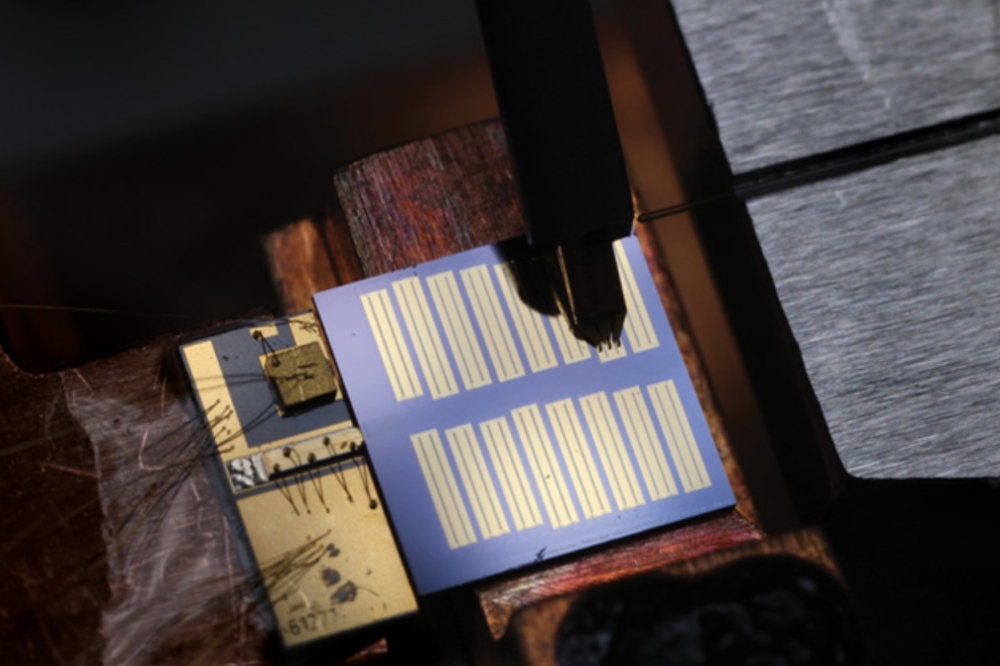
Using the concept, researchers successfully addressed a neuromorphic photonic processor featuring 17 optical ports, demonstrating the potential for automated and reproducible assembly of photonic systems.
The plug-and-play coupling method could support scalable manufacturing of PIC-based technologies and hybrid electronic-photonic systems, with potential applications spanning AI hardware, optical communications, and sensing platforms.