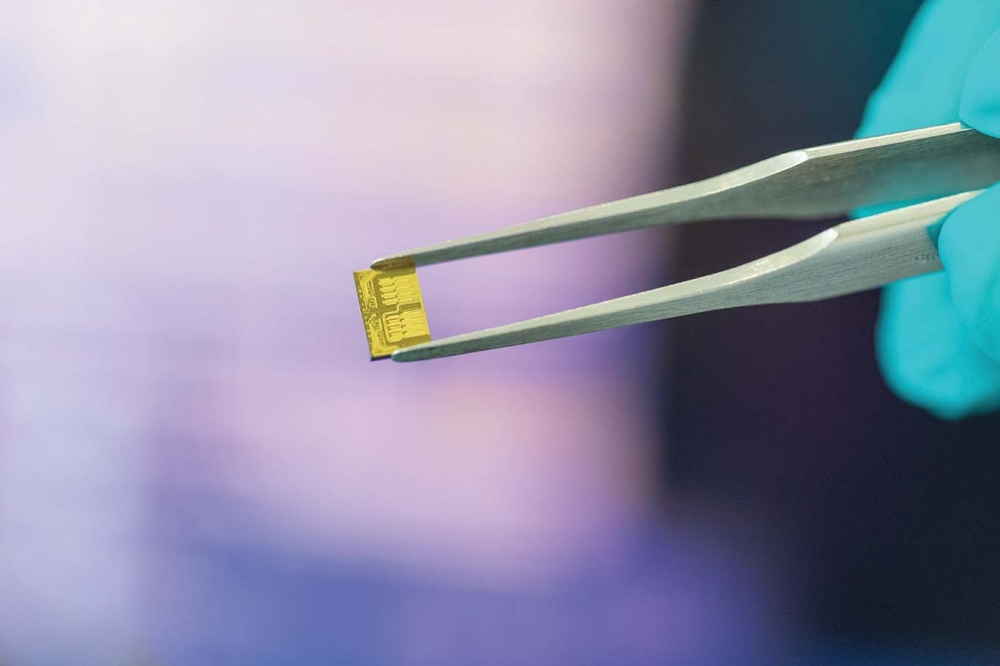
Organic device emits and harvests light

Researchers in Japan have developed an organic semiconductor device capable of both generating electricity from light and emitting visible light, opening a potential pathway toward self-powered displays and multifunctional optoelectronics.
Researchers from the Institute of Science Tokyo and collaborating institutions have demonstrated an organic semiconductor device that can simultaneously harvest light and emit it, marking a step toward multifunctional optoelectronic systems and power-generating displays.
The team developed the device using multi-resonance thermally activated delayed fluorescence (MR-TADF) materials, engineered to minimise non-radiative energy losses that typically reduce efficiency in organic semiconductors.
Using OLED-associated materials v-DABNA and QAO in a layered structure, the researchers achieved both 1.36% power-conversion efficiency and 2.0% light-emission efficiency within a single device.
The system also produced bright red emission at 1,000 cd/m2 while operating at 3.2V, compatible with standard lithium-ion battery voltages.
According to the researchers, the work demonstrates simultaneous light emission, energy harvesting and photodetection within a single organic platform, establishing a new framework for multifunctional optoelectronics.
The team said the technology could support future applications including self-powered displays, wearable electronics, transparent photovoltaics and integrated sensor systems, where lightweight and flexible organic materials offer advantages over conventional inorganic semiconductor platforms.