Ultrafast laser technique advances quantum photonics
Researchers in Berlin demonstrate a new method for generating single photons in diamond-based quantum systems, improving efficiency and bringing quantum networks closer to practical deployment.
Researchers from Humboldt University of Berlin and Ferdinand-Braun-Institut have demonstrated a new method for generating single photons in diamond-based quantum systems, marking progress toward scalable quantum communication technologies.
The study, published in Nature Communications, introduces the SUPER (Swing-UP of the quantum EmitteR population) method, which enables more controlled and efficient generation of photons from diamond defects known as tin vacancy (SnV) centres.
These defects act as stable quantum bits, capable of storing and processing quantum information while coupling it to light particles.
Generating and detecting single photons reliably remains a key challenge for quantum technologies such as quantum networks and distributed quantum computing. Conventional techniques often rely on complex filtering methods that reduce efficiency and limit scalability.
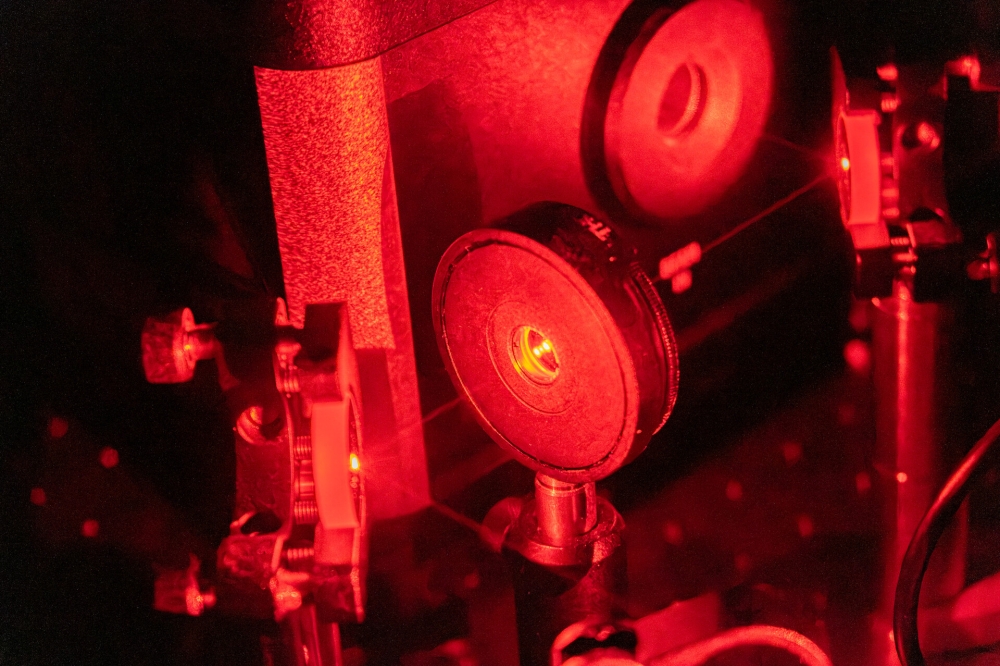
The SUPER method addresses this challenge by using two precisely tuned ultrafast laser pulses to excite the quantum system, making it easier to separate the control lasers from the emitted photons that carry the quantum information.
The team used femtosecond laser pulses to control the qubits, enabling optical operations on extremely short time scales.
According to the researchers, this approach allows more precise control of the quantum state while maintaining the integrity of the system’s internal spin state, a critical requirement for generating quantum entanglement between distant nodes in a quantum network.
The research combines diamond nanofabrication, ultrafast optical technologies, and theoretical modelling.
Together, these techniques demonstrate that the SUPER method could serve as a powerful tool for solid-state quantum photonics, potentially supporting future quantum repeaters and large-scale quantum communication networks.