Programmable slow-light enables reconfigurable photonics

Researchers from Seoul National University and collaborators have demonstrated a fully programmable slow-light system for photonic integrated circuits (PICs) using a spinor-based coupled-resonator-induced transparency (CRIT) framework.
By representing bright and dark resonator modes with spinors and employing dual-channel gauge fields, the team achieved unprecedented control over spectral features, including linewidth, asymmetry, and lattice dispersion.
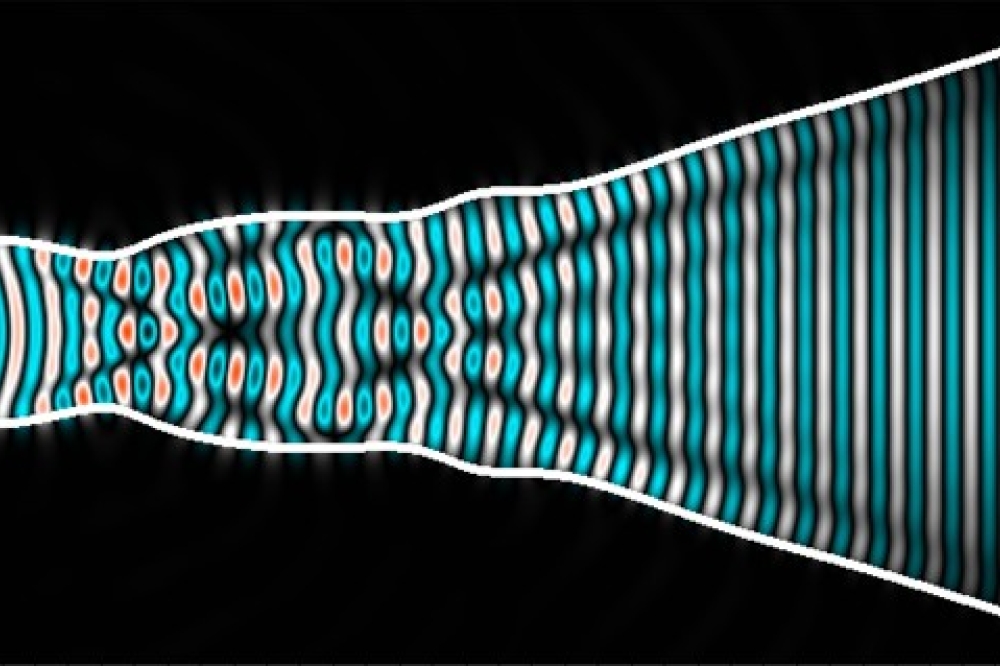
The one-dimensional CRIT lattice supports a tunable slow-light band and enables critical photonic functionalities such as tunable delay lines, reconfigurable synchronisation, and linear frequency conversion, all within a compact 0.25 mm² footprint at telecom wavelengths.
This advancement provides a versatile building block for programmable photonic circuits, opening pathways for more flexible and dense on-chip optical signal processing.
“The spinor-based approach allows dynamic control over light propagation, moving beyond traditional electromagnetically induced transparency methods,” the researchers note, highlighting the potential for next-generation integrated photonics and optical interconnect applications.