UC Davis develops AI spectrometer chip

UC Davis develops AI-powered spectrometer-on-a-chip, delivering lab-grade optical sensing in a sub-millimetre photonic device.
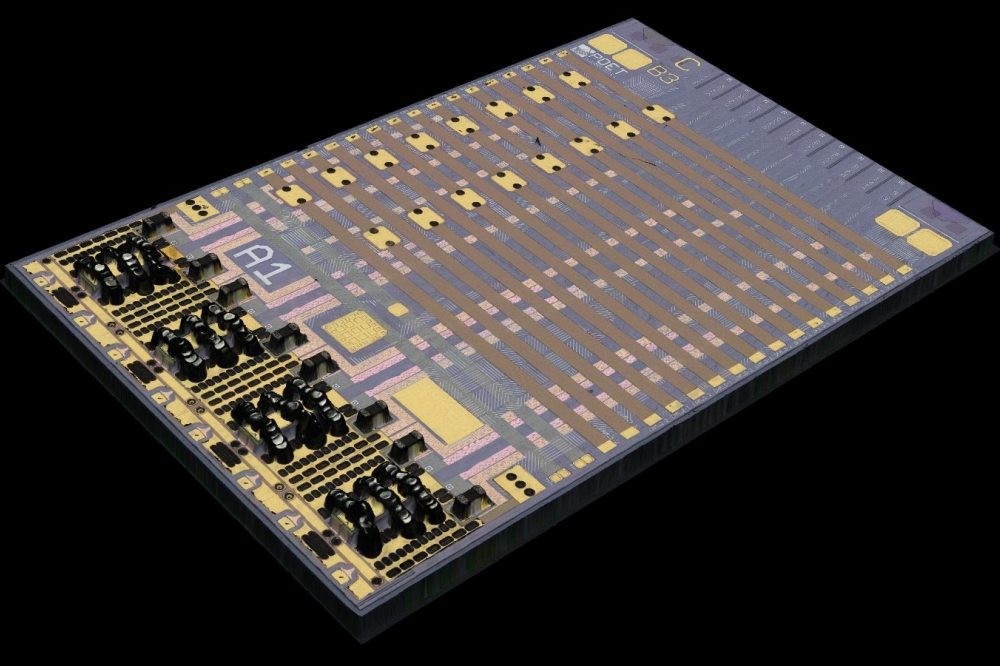
Researchers at the University of California, Davis, have demonstrated a spectrometer-on-a-chip that shrinks laboratory-grade optical sensing to a footprint smaller than a grain of sand.
The device combines nanostructured silicon photodetectors with artificial intelligence, eliminating the need for bulky optical components traditionally required for spectral analysis.
Instead of separating light using prisms or gratings, the chip employs 16 silicon photodetectors, each engineered with photon-trapping surface nanostructures that respond differently to incoming light.
These engineered surfaces extend silicon’s sensitivity into the near-infrared, a spectral region that is typically challenging for standard silicon photodiodes.
A fully connected neural network reconstructs the incoming light spectrum by learning the relationship between the detectors’ encoded signals and the original spectrum.
The AI-based approach solves the inverse problem of spectral reconstruction, achieving approximately 8 nm resolution while maintaining high noise tolerance.
The chip occupies just 0.4 mm² and integrates high-speed sensing capabilities that also enable ultra-fast measurements of photon lifetime.
According to the researchers, the compact, low-power platform could enable real-time hyperspectral sensing in portable devices.
Led by postdoctoral researcher Ahasan Ahamed in the lab of Saif Islam, professor and chair of the Electrical and Computer Engineering department at UC Davis, the work points toward future photonic integrated circuits that combine nanophotonic structures with machine learning for applications ranging from medical diagnostics to environmental sensing.