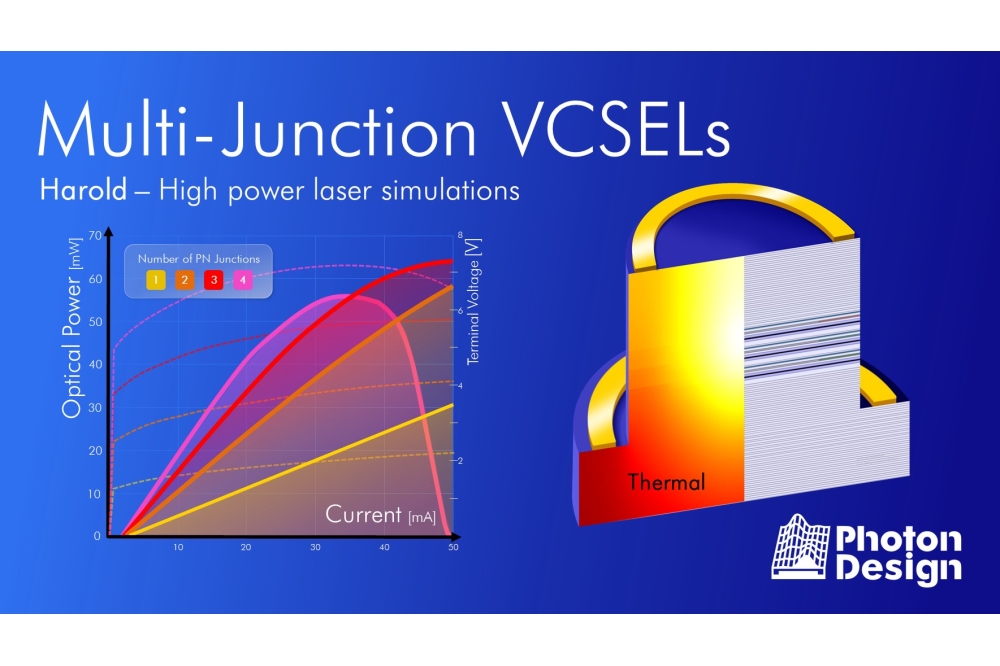
Photon Design has introduced multi-junction Vertical-Cavity Surface-Emitting Laser (VCSEL) simulation capabilities to its HAROLD photonic simulation tool, enabling engineers to model and optimise high-power VCSEL designs before fabrication.
Unlike conventional VCSELs, multi-junction devices stack multiple gain junctions vertically within the epitaxial structure, allowing the same current to generate higher optical output power.
The approach can also improve device lifetime and reliability by delivering comparable power at lower operating currents, reducing heat generation.
Within HAROLD, designers can perform integrated 3D optical, electrical and thermal simulations to evaluate the performance of multi-junction VCSELs.
The software provides band diagrams using 3D drift-diffusion modelling, analyses current-induced temperature gradients and their impact on gain, and predicts output power by combining simulated gain spectra with the 3D optical profile of distributed Bragg reflector (DBR) gratings.
The new capability supports the development of VCSELs for high-speed datacom, machine vision, automotive LiDAR and consumer 3D sensing applications, where demand for higher optical power and improved efficiency continues to grow.
“Photon Design’s HAROLD simulation tool supports the demanding design requirements of multi-junction VCSELs, providing 3D optical, electrical and thermal simulations,” said Dr Dominic Gallagher, CEO of Photon Design.
“HAROLD shows engineers how additional junctions can raise output power before efficiency then declines as a result of losses in what is now a larger epitaxy structure.”