Hybrid PIC broadens light generation

Researchers have combined Raman lasing and Kerr frequency comb generation in a hybrid silicon nitride–silica photonic chip, demonstrating a new approach to broadband on-chip light sources for integrated photonics.
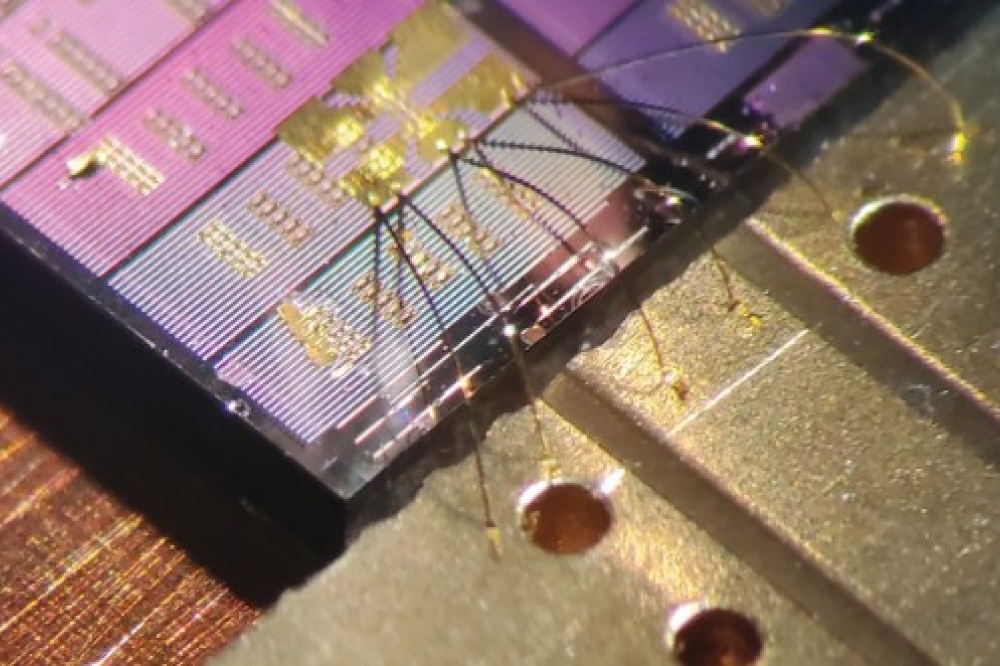
Researchers have demonstrated a hybrid photonic integrated circuit (PIC) that combines two nonlinear optical effects in separate materials, creating a broadband on-chip light source with potential applications in communications, sensing and precision measurement.
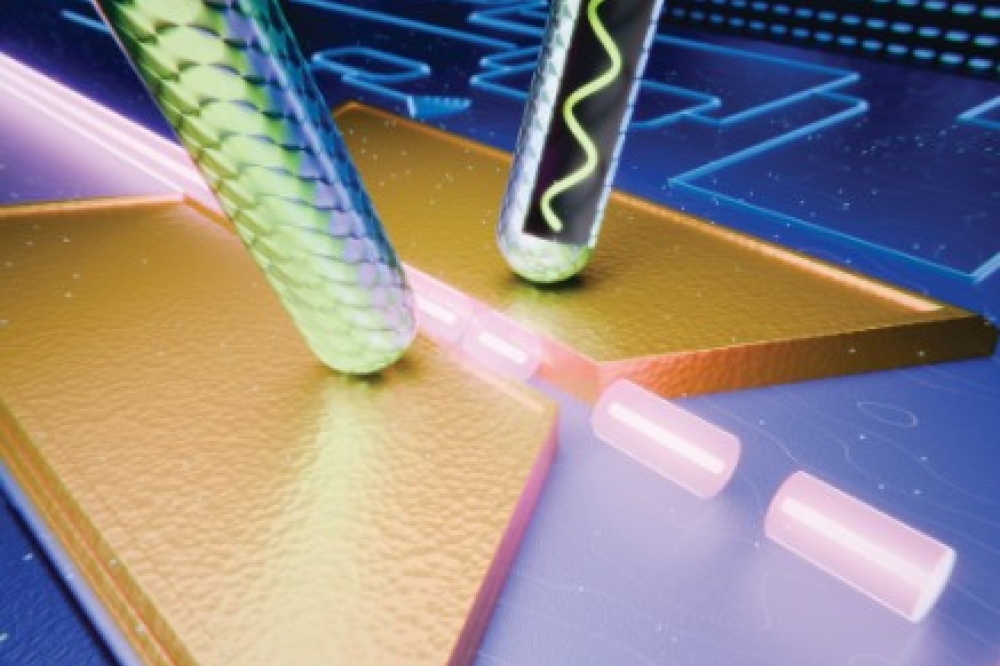
Published in Advanced Photonics, the study introduces a silicon nitride ring resonator surrounded by a silica cladding, enabling Kerr frequency comb generation in the silicon nitride core while simultaneously harnessing Raman scattering in the silica layer.
By allowing approximately 31% of the circulating optical field to overlap with the cladding, the device enables both materials to contribute distinct optical functions within a single integrated platform.
The approach led to the first demonstration of Raman lasing in a silicon nitride integrated photonic device.
As optical power increased, Raman-generated Stokes and anti-Stokes sidebands evolved into broadband Kerr frequency combs through four-wave mixing, producing comb spectra spanning more than 400 nm.
The researchers also optimized the waveguide geometry to improve mode interactions, achieving a power conversion efficiency exceeding 32%.
Experimental measurements closely matched theoretical predictions, with Raman lasing occurring at an on-chip threshold of approximately 143 mW.
The work highlights a new design strategy for integrated photonics, showing how multiple materials can be combined within a single PIC to exploit complementary nonlinear properties.
The researchers suggest the concept could enable future broadband supercontinuum sources, self-referenced frequency combs and other advanced integrated light sources for next-generation photonic systems.